
Centre for Quantum Computing
and Applications
QSTAR will develop new error correction methods, algorithms and software necessary for quantum computers to become reliable and useful
QSTAR has officially launched!
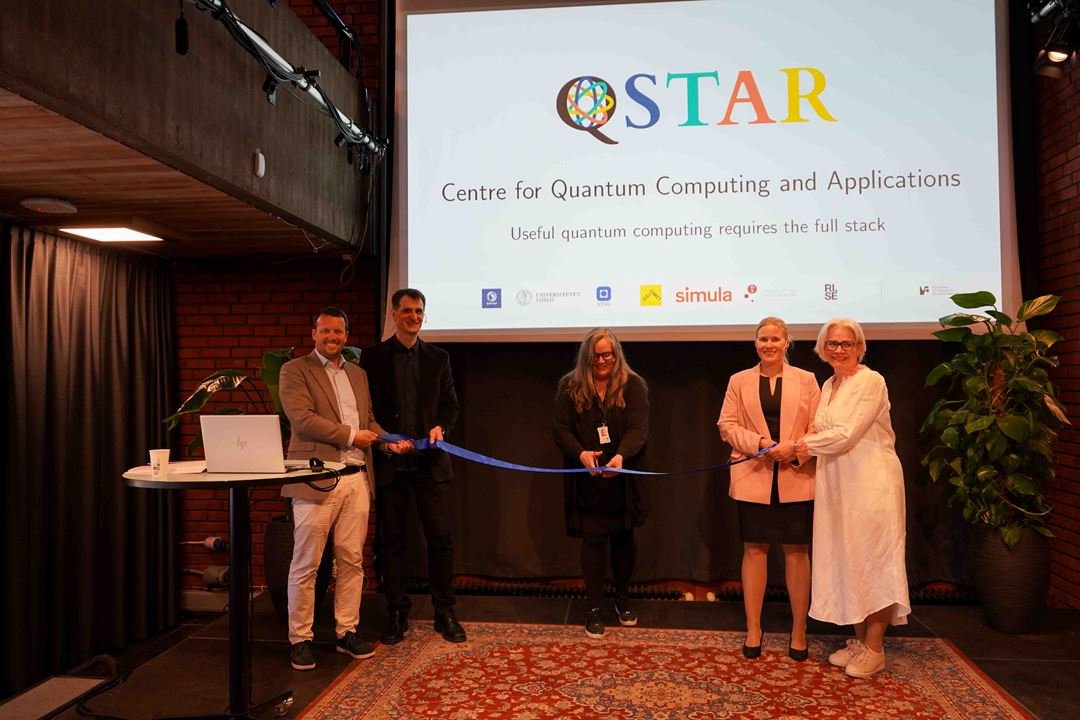
Photo: William Husby Hoven / SINTEF
"The field of quantum computing holds great promise, but QSTAR will be working on the factors that determine whether that promise can actually be fulfilled: error correction, algorithms, software and practical applications"
— Director of QSTAR, Franz Fuchs
Read full article at SINTEFAdvancing Quantum Computing
The research targets challenging tasks in both research and industry, particularly in quantum chemistry and optimization, as test areas with high scientific and industrial relevance. The center will also educate the next generation of experts through PhD and master's programs, seminars, and international mobility.
Quantum Software for Fault-Tolerant Architectures
The characteristics of particular fault-tolerance schemes create special constraints on how to efficiently implement and benchmark quantum algorithms.
Quantum Random Walks
We develop a unifying algorithmic substrate linking, compilation and design of walk-based quantum algorithms with application domains, such as risk modelling and network optimisation.
Quantum Chemistry
We hypothesise that unified compilation frameworks can significantly reduce hardware bottlenecks, and that systematically optimised UCC/GCR ansätze can reach chemically accurate results on near-term and fault-tolerant devices.
About the centre
QSTAR is hosted and led by SINTEF, with Franz Fuchs (SINTEF) as director and Ida-Marie Høyvik (NTNU) as co-director. Our research partners are the University of Oslo, NTNU, OsloMet and Simula Research Laboratory, together with QMATH at the University of Copenhagen and RISE in Sweden. The centre is funded by the Research Council of Norway for five years.
Partners